The Henson Trust: Providing Financial Security for Those with Special Needs

When considering the arrangements for managing an individual’s finances and assets after their passing, it is vital to be aware of the existence of the Henson Trust. This type of trust helps ensures that people with disabilities or special needs can still have money to take care of them without losing their government benefits. It’s named after a court case in Canada and can help families take care of their loved ones in a smart way.


How the Henson Trust Started: A Big Court Case

The case revolved around Marguerite Henson and her daughter Audrey. Audrey faced challenges due to a disability, requiring additional assistance. Marguerite’s concern was ensuring that Audrey’s financial well-being was secure even after Marguerite’s passing. However, Marguerite didn’t want Audrey’s ability to receive government assistance to be compromised.

In its ruling, the court determined that the funds held in a special trust for Audrey shouldn’t be considered as her personal assets. This crucial decision allowed Audrey to maintain her eligibility for government support despite having funds saved. This ruling set a precedent that provided guidance for other families in similar situations, enabling them to also ensure the welfare of their loved ones without jeopardizing their access to government assistance.


What the Henson Trust Does and How It Helps

A Henson Trust presents a distinct method of setting aside funds for an individual who requires additional assistance due to a disability. Unlike conventional savings approaches, the beneficiary of the funds does not retain control over them. Instead, a designated trustee assumes the responsibility of determining the timing and way the funds are utilized to benefit the individual. This approach is intended to prevent the funds from being considered the individual’s personal assets, thus enabling them to maintain eligibility for government assistance.

Several advantageous aspects of a Henson Trust encompass:

  1. Keeping Government Benefits: The best thing about this trust is that it lets people get government help even if they have some money saved up. This way, they can have a better life without losing important benefits.
  2. Extra Support: The trust gives extra funds to the person who needs it. This can be used for things like medical bills, a place to live, education, and fun activities that make life better.
  3. Someone You Trust Takes Care: A trustee is chosen to look after the money in the trust. They make sure the money is used in the best way for the person who needs help.
  4. Different Ways to Save: Families can put money into the trust from things like insurance, investments, property, or other valuable things.


Things to Think About When Using a Henson Trust

Using a Henson Trust needs careful thinking and planning. Here are some important things to know:

  1. Choosing the Right Trustee: The trustee is a big part of the trust. They’re the ones who take care of the money and decide how to spend it. It’s important to choose someone who knows what the person with special needs really needs and can make good choices.
  2. Making Clear Plans: Establishing Clear Strategies: The documentation that forms the basis of the trust must exhibit utmost clarity. This ensures that all parties involved are well-informed about the intended course of action concerning the funds, thus eliminating any potential confusion.
  3. Regular Evaluation and Revisions: Given that circumstances can evolve, it’s prudent to periodically review the trust to ensure it remains suitable for the individual requiring assistance.
  4. Seeking Expert Advice: Engaging in discussions with a specialized attorney or financial advisor can be tremendously advantageous. Their expertise in matters related to these types of trusts can provide invaluable guidance to families, aiding them in making well-informed decisions.


The Henson Trust offers families a unique way to ensure that their family members with disabilities or distinct needs possess the financial resources necessary for a quality life. This trust plays a crucial role in maintaining government support while also offering supplementary funds for essential expenditures. It’s important for families to engage in meticulous planning, select an appropriate trustee, and seek guidance from experts to establish a future that is both secure and fulfilling for their special loved ones.

What is disability insurance?

If you cannot work because you are seriously injured or ill, disability insurance will provide you with a monthly, tax-free income to help replace your lost wages.  An injury does not have to be as blatant as a broken leg or arm – suffering from chronic pain or dealing with mental health issues can also qualify you for a disability insurance payout.  

Why do I need disability insurance?

Unfortunately, people become disabled – whether temporarily or permanently – quite often. In 2017, over 20 percent of Canadians had one or more disabilities. 

If you’re disabled, you may lose one of your most valuable assets – your ability to work and bring in a paycheck. Disability insurance can help replace that paycheck for as long as you need it to. Being able to rely on a disability insurance payout means you won’t have to dip into your savings if anything happens to you.

Disability insurance is especially important if you are self-employed, particularly if you are the family’s sole income earner.

What if I already have disability insurance through work?

If you have disability insurance through work, that’s great – but it may not replace 100 percent of your paycheck, especially if you’re off work for a long time. If you purchase private disability insurance, you can:

  • Choose how much coverage you want.
  • Adjust your coverage as needed.
  • Not have to worry if you leave your employer – you won’t lose your disability insurance coverage.

Having private disability insurance will give you peace of mind that you either have additional coverage if you are employed and at least some disability coverage if you lose your job.

How does disability insurance work?

We’d be happy to answer any questions you have about disability insurance. There are five main steps to disability insurance:

  1. Determine the amount of coverage you want. The higher your salary, the more coverage you should get.
  2. Pay your monthly premiums. Factors like your health, your age, and the amount of coverage you have will all impact the cost of your premiums.
  3. File a claim if you become disabled – we can help you with this.
  4. Receive your monthly payments once your waiting period has passed – a longer waiting period can lower your premiums, but it does mean you’ll go longer without any income.
  5. When you are healthy enough to return to work, or your coverage period runs out, you will stop receiving disability insurance payments.

We’re Here To Help

If you’d like to know more about disability insurance – from how much it would cost you to what you can file a claim for – we’re here to help! Give us a call today.

Empowering Your Family’s Financial Future: A Comprehensive Guide to Budgeting

Taking charge of your family’s financial well-being through effective budgeting is a crucial step in securing a brighter future. We’ll explore the significance of budgeting and provide practical tips to help you manage your money wisely while ensuring the best possible support for your loved ones, including those with disabilities and their Registered Disability Savings Plan (RDSP).

Why Budgeting Matters for Families

Budgeting is a powerful financial tool that holds importance for all families:

  1. Financial Clarity: It offers a clear overview of your family’s income and expenses, helping you make informed decisions about allocating funds.
  2. Goal Achievement: Budgeting helps you allocate funds not only for your loved one’s RDSP but also for other family financial goals, such as saving for education or a home.
  3. Expense Control: It identifies areas where you can cut back on expenses, freeing up money for your family’s financial priorities.
  4. Debt Reduction: By tracking spending, you can allocate extra funds to pay down debt faster, ensuring your family’s financial stability.
  5. Emergency Preparedness: A budget provides a financial safety net for unexpected expenses, which can be especially critical for families with additional financial responsibilities.

Steps to Effective Budgeting for Families

  1. Calculate Income: Determine your total monthly income, including salaries, government benefits, and any disability-related support for your loved one.
  2. List Expenses: Categorize expenses into fixed (e.g., housing, utilities) and variable (e.g., groceries, entertainment).
  3. Set Financial Goals: Define short-term and long-term financial goals for your family, ensuring that your loved one’s RDSP contributions are part of the plan.
  4. Create a Budget: Use budgeting tools or apps to allocate income to expenses, savings, and financial goals without exceeding your income.
  5. Monitor and Adjust: Regularly track spending against your budget, making necessary adjustments to ensure your family’s financial health.

Tips for Successful Budgeting

  1. Be Realistic: Set achievable goals and create a budget that accommodates your family’s unique needs, including the financial responsibilities associated with the RDSP.
  2. Prioritize Savings: Ensure that contributing to your loved one’s RDSP is a top financial priority, but don’t forget to save for other family goals too.
  3. Emergency Fund: Maintain an emergency fund to cover unexpected expenses, which can benefit all family members.
  4. Review and Cut Expenses: Periodically review expenses to find areas where you can save and allocate more funds to your family’s financial priorities.
  5. Pay Yourself First: Treat savings, including RDSP contributions, as non-negotiable expenses, just like other essential bills.
  6. Seek Professional Advice: Consult a financial advisor who specializes in disability-related financial planning for tailored guidance.

Budgeting is your family’s pathway to financial security and ensuring a brighter financial future. By budgeting wisely and prioritizing your loved one’s financial well-being, you can control your family’s finances, reduce stress, and work towards a future filled with financial peace of mind. Remember, financial success for families means making informed choices that align with your values and aspirations. Start budgeting today to achieve financial wellness for your entire family, balancing the needs of all family members, including those who rely on the support of the RDSP.

Insurance Planning for Incorporated Professionals

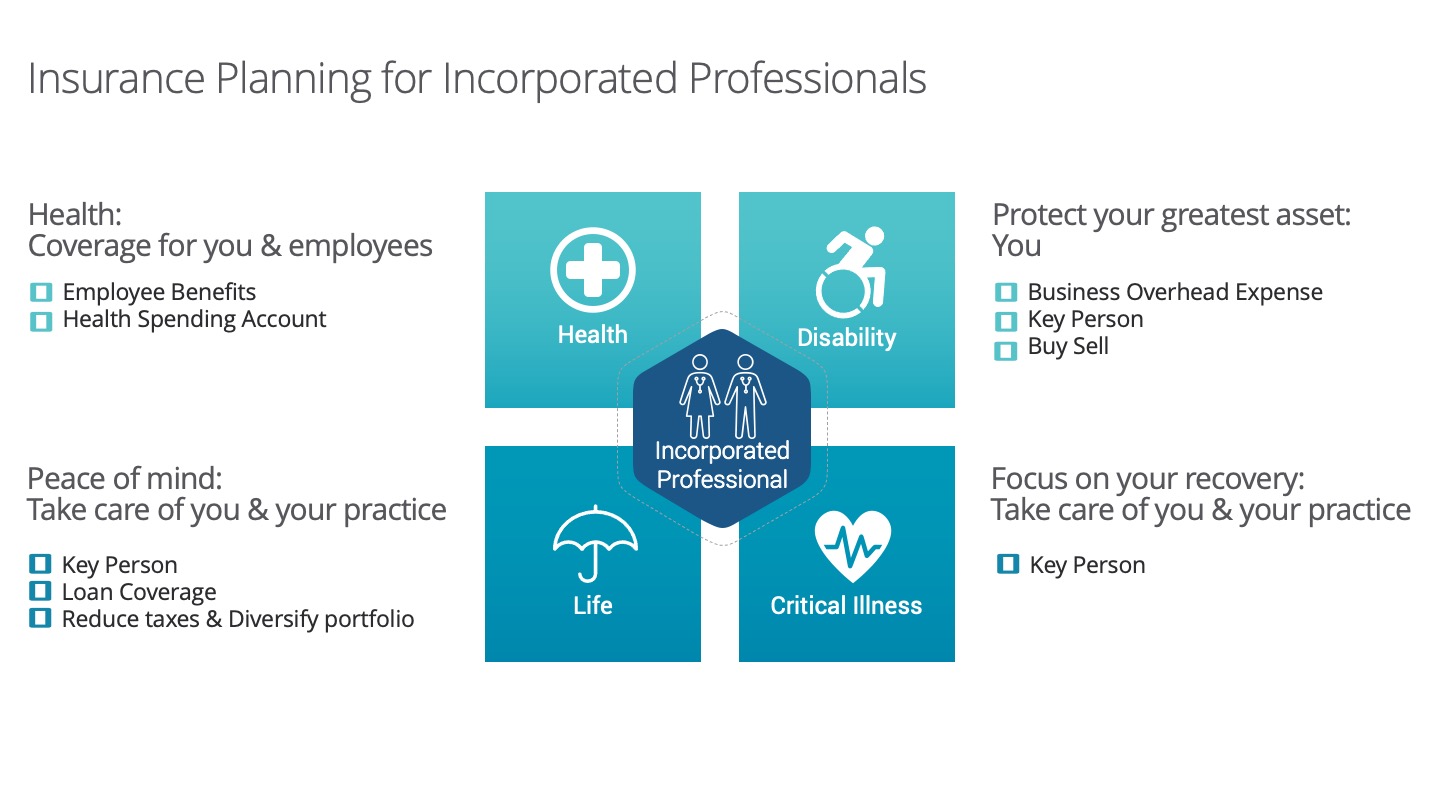
For incorporated professionals, making sure your practice is financially protected can be overwhelming. Incorporated professionals face a unique set of challenges when it comes to managing risk. Insurance can play an important role when it comes to reducing the financial impact on your practice in the case of uncontrollable events such as disability, or critical illness. This infographic and article address the importance of corporate insurance.

The 4 areas of insurance a incorporated professional should take care of are: 

  • Health 

  • Disability 

  • Critical Illness 

  • Life

Health: We are fortunate in Canada, where the healthcare system pays for basic healthcare services for Canadian citizens and permanent residents. However, not everything healthcare related is covered, in reality, 30% of our health costs* are paid for out of pocket or through private insurance such as prescription medication, dental, prescription glasses, physiotherapy, etc.

For incorporated professionals, offering employee health benefits make smart business sense because health benefits can form part of a compensation package and can help retain key employees and attract new talent.

For incorporated professionals that are looking to provide alternative health plans in a cost effective manner, you may want to consider a health spending account.

Disability: Most people spend money on protecting their home and car, but many overlook protecting their greatest asset: their ability to earn income. Unfortunately one in three people on average will be disabled for 90 days or more at least once before the age of 65.

Consider the financial impact this would have on your practice if you or a key employee were to suffer from an injury or illness. Disability insurance can provide a monthly income to help keep your practice running.

Business overhead expense insurance can provide monthly reimbursement of expenses during total disability such as rent for commercial space, utilities, employee salaries and benefits, equipment leasing costs, accounting fees, insurance premiums for property and liability, etc.

Key person disability insurance can be used to provide monthly funds for you or key employee while they’re disabled and protect the business from lost revenue while your business finds and trains an appropriate replacement.

Critical Illness: For a lot of us, the idea of experiencing a critical illness such as a heart attack, stroke or cancer can seem unlikely, but almost 3 in 4 (73%) working Canadians know someone who experience a serious illness. Sadly, this can have serious consequences on you, your family and business, with Critical Illness insurance, it provides a lump sum payment so you can focus on your recovery.

Key person critical illness insurance can be used to provide funds to the practice so it can supplement income during time away, cover debt repayment, salary for key employees or fixed overhead expenses.

Buy sell critical illness insurance can provide you with a lump sum payment if your business partner or shareholder were to suffer from a critical illness. These funds can be used to purchase the shares of the partner, fund a buy sell agreement and reassure creditors and suppliers.

Life: For an incorporated professional, not only do your employees depend on you for financial support but your loved ones do too. Life insurance is important because it can protect your practice and also be another form of investment for excess funds.

Key person life insurance can be used to provide a lump sum payment to the practice on death of the insured so it can keep the business going until you an appropriate replacement is found. It can also be used to retain loyal employees by supplying a retirement fund inside the insurance policy.

Loan coverage life insurance can help cover off any outstanding business loans and debts.

Reduce taxes & diversify your portfolio, often life insurance is viewed only as protection, however with permanent life insurance, there is an option to deposit excess funds not needed for operations to provide for tax-free growth (within government limits) to diversify your portfolio and reduce taxes on passive investments.  

Talk to us to make sure you and your practice are protected.

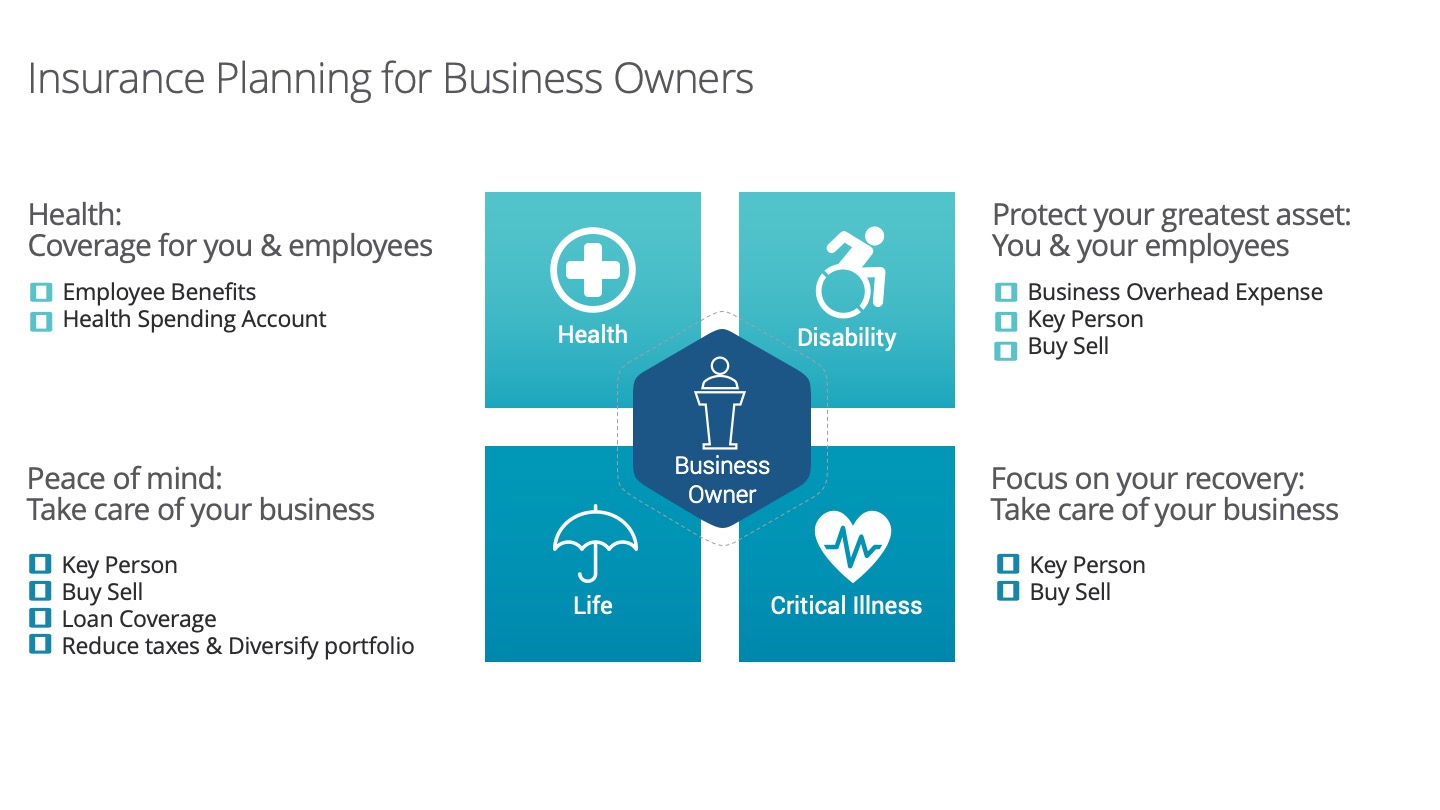
Insurance Planning for Business Owners

For business owners, making sure your business is financially protected can be overwhelming. Business owners face a unique set of challenges when it comes to managing risk. Insurance can play an important role when it comes to reducing the financial impact on your business in the case of uncontrollable events such as disability, critical illness or loss of a key shareholder or employee.

This infographic addresses the importance of corporate insurance.

The 4 areas of  insurance a business owner should take care of are:

  • Health

  • Disability

  • Critical Illness

  • Life

Health: We are fortunate in Canada, where the healthcare system pays for basic healthcare services for Canadian citizens and permanent residents. However, not everything healthcare related is covered, in reality, 30% of our health costs* are paid for out of pocket or through private insurance such as prescription medication, dental, prescription glasses, physiotherapy, etc.

For business owners, offering employee health benefits make smart business sense because health benefits can form part of a compensation package and can help retain key employees and attract new talent.

For business owners that are looking to provide alternative health plans in a cost effective manner, you may want to consider a health spending account.

Disability: Most people spend money on protecting their home and car, but many overlook protecting their greatest asset: their ability to earn income. Unfortunately one in three people on average will be disabled for 90 days or more at least once before the age of 65.

Consider the financial impact this would have on your business if you, a key employee or shareholder were to suffer from an injury or illness. Disability insurance can provide a monthly income to help keep your business running.

Business overhead expense insurance can provide monthly reimbursement of expenses during total disability such as rent for commercial space, utilities, employee salaries and benefits, equipment leasing costs, accounting fees, insurance premiums for property and liability, etc.

Key person disability insurance can be used to provide monthly funds for the key employee while they’re disabled and protect the business from lost revenue while your business finds and trains an appropriate replacement.

Buy sell disability insurance can provide you with a lump sum payment if your business partner were to become totally disabled. These funds can be used to purchase the shares of the disabled partner, fund a buy sell agreement and reassure creditors and suppliers.

Critical Illness: For a lot of us, the idea of experiencing a critical illness such as a heart attack, stroke or cancer can seem unlikely, but almost 3 in 4 (73%) working Canadians know someone who experience a serious illness. Sadly, this can have serious consequences on you, your family and business, with Critical Illness insurance, it provides a lump sum payment so you can focus on your recovery.

Key person critical illness insurance can be used to provide funds to the company so it can supplement income during time away, cover debt repayment, salary for key employees or fixed overhead expenses.

Buy sell critical illness insurance can provide you with a lump sum payment if your business partner or shareholder were to suffer from a critical illness. These funds can be used to purchase the shares of the partner, fund a buy sell agreement and reassure creditors and suppliers.

Life: For a business owner, not only do your employees depend on you for financial support but your loved ones do too. Life insurance is important because it can protect your business and also be another form of investment for excess company funds.

Key person life insurance can be used to provide a lump sum payment to the company on death of the insured so it can keep the business going until you an appropriate replacement is found. It can also be used to retain loyal employees by supplying a retirement fund inside the insurance policy.

Buy sell life insurance can provide you with a lump sum payment if your business partner or shareholder were to pass away. These funds can be used to purchase the shares of the deceased partner, fund a buy sell agreement and reassure creditors and suppliers.

Loan coverage life insurance can help cover off any outstanding business loans and debts.

Reduce taxes & diversify your portfolio, often life insurance is viewed only as protection, however with permanent life insurance, there is an option to deposit excess company funds not needed for operations to provide for tax-free growth (within government limits)  to diversify your portfolio and reduce taxes on passive investments.

Talk to us about helping making sure you and your business are protected.

Insurance Planning for Young Families

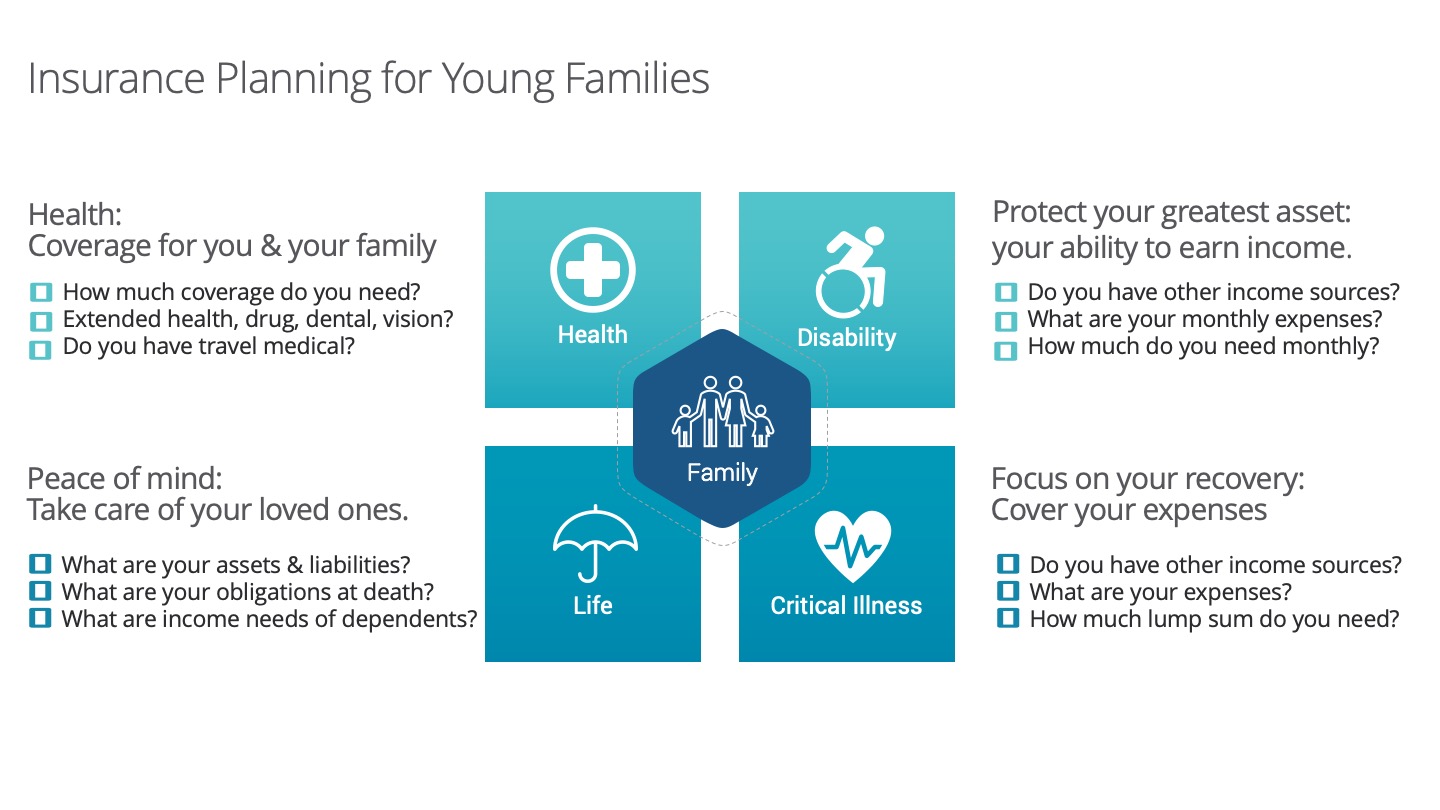
For young families, making sure your family is financially protected can be overwhelming, especially since there’s so much information floating online. This infographic addresses the importance of insurance- personal insurance.

The 4 areas of personal insurance a young family should take care of are:

  • Health

  • Disability

  • Critical Illness

  • Life

Health: We are so fortunate to live in Canada, where the healthcare system pays for basic healthcare services for Canadian citizens and permanent residents. However, not everything healthcare related is covered, in reality, 30% of our health costs* are paid for out of pocket or through private insurance such as prescription medication, dental, prescription glasses, physiotherapy, etc.. Moreover, if you travel outside of Canada, medical emergencies can be extremely expensive.

Disability: Most people spend money on protecting their home and car, but many overlook protecting their greatest asset: their ability to earn income. Unfortunately one in three people on average will be disabled for 90 days or more at least once before age 65. Disability insurance can provide you with a portion of your income if you were to become disabled and unable to earn an income.

Critical Illness: For a lot of us, the idea of experiencing a critical illness such as a heart attack, stroke or cancer can seem unlikely, but almost 3 in 4 (73%) working Canadians know someone who experience a serious illness. Sadly, this can have serious consequences on you and your family, with Critical Illness insurance, it provides a lump sum payment so you can focus on your recovery.

Life: For young families, if your loved ones depend on you for financial support, then life insurance is absolutely necessary, because it replaces your income, pay off your debts and provides peace of mind.

Talk to us about helping making sure you and your family are protected.