Corporate Life Insurance Planning

Corporate Life Insurance Planning: Protect, Reward, and Plan for the Future

Running a business in often means wearing multiple hats—owner, leader, and long-term planner. But have you ever thought about what happens if you or a key person in your company passes away unexpectedly? Or how you might use your corporation to support retirement, reward top talent, or prepare for taxes when transitioning ownership?

Corporate life insurance is one of the most flexible and underused tools available to business owners. It helps protect your company, reduce taxes, and build lasting value—both during your working years and when it’s time to pass the business on.

Let’s look at how business owners are using corporate-owned life insurance to protect their companies and their families while preparing for the future.

brandableContent

Succession Planning: Make Transitions Smooth and Tax-Smart

For many business owners, their company is one of their largest assets. But passing it on—whether to family or a partner—comes with major financial challenges. Life insurance can help.

Funding a Buy-Sell Agreement

If you have a business partner, a buy-sell agreement ensures that if one of you passes away, the other can buy the shares from the deceased’s estate. The problem? That buyout requires cash—often hundreds of thousands, if not millions. Life insurance is a cost-effective way to fund that agreement, so ownership stays in the right hands without putting a strain on the business or the family.

Covering Final Taxes and Capital Gains

When a business owner dies, the Canada Revenue Agency treats it as if they sold their shares—even if they didn’t. This “deemed disposition” creates a tax bill that can surprise even the most prepared families. Life insurance provides a tax-free lump sum that the corporation can use to cover this cost, helping preserve the value of the business and avoid selling off assets under pressure.

Estate Equalization

If you plan to leave the business to one child but want to treat your other children fairly, life insurance can help. The business goes to the child who’s involved, while other beneficiaries receive the life insurance proceeds. It’s a clean, tax-efficient way to avoid family conflict and keep the business whole.

Executive Compensation: Attract and Retain Top Talent

In a competitive hiring environment, offering the right benefits can make all the difference. Life insurance isn’t just about protection—it can be a powerful way to reward and retain your most valuable people.

Executive Compensation Strategies

Life insurance can be part of a compensation package that rewards top performers, especially those who are key to the company’s success. Whether structured as a bonus plan or part of a long-term incentive, this can be a powerful way to align goals and build loyalty.

Retirement Funding

Permanent life insurance policies (like whole life or universal life) build cash value over time. That value grows tax-deferred and can be accessed through policy loans or collateralized lending. Business owners and executives often use this as an additional retirement income stream, especially if they’ve already maxed out RRSP or TFSA contributions.

Tax-Sheltered Wealth Accumulation

The cash value inside a permanent life insurance policy grows on a tax-deferred basis. When a corporation owns the policy, this growth can be especially strategic. It allows the business to use surplus cash to build value in a tax-efficient way, diversify beyond traditional investments, and potentially access funds later with fewer tax consequences. This approach is particularly useful for businesses with retained earnings that would otherwise be subject to higher corporate tax rates.

Business Continuity: Protect What You’ve Built

An unexpected death can do more than cause emotional pain—it can disrupt operations, shake client confidence, and even put the business at risk. Insurance helps ensure your company can keep going.

Key Person Protection

If you or someone else is essential to the day-to-day success of your business, losing that person could be a major financial blow. A life insurance policy on that individual can help the business recover, cover short-term losses, and fund the search for a replacement.

Business Loan Protection

Many lenders require insurance on owners or key executives as a condition of financing. If that person passes away, life insurance ensures the loan is paid off, protecting both the lender and the company’s assets. It can also unlock better lending terms and help avoid personal guarantees.

Charitable Giving Through the Corporation

For business owners looking to give back, corporate life insurance can also be used to support charitable causes. The business can own a policy and name a charity as the beneficiary—creating a lasting impact while offering potential tax benefits.

Bringing It All Together

Corporate life insurance isn’t just about “what if”—it’s about building a stronger, more resilient business and unlocking smart ways to manage wealth inside your company. Whether you’re focused on succession, rewarding your team, or protecting operations, insurance can help you take action today that pays off for years to come.

If you haven’t reviewed your corporate insurance strategy recently, now’s a great time to take a fresh look.

Disclaimer: This article is for informational purposes only and does not constitute financial, legal, or tax advice. Always consult a qualified professional regarding your specific situation. We are not responsible for any actions taken based on this content.

The Health Spending Account for Business Owners and Incorporated Professionals

Are you tired of using your hard-earned after-tax dollars to cover medical expenses? As a business owner, the burden of managing healthcare costs can be overwhelming. However, there’s a little-known solution that can alleviate this financial strain – the Health Spending Account.

Designed specifically for entrepreneurs like you, the Health Spending Account offers a tax-efficient way to manage medical expenses. Say goodbye to paying out of pocket with after-tax dollars for your healthcare needs, and let’s explore the advantages of this specialized account tailored to meet the unique needs of business owners and incorporated professionals.

Who’s eligible?

The Health Spending Account is available to a wide range of businesses, making it an inclusive and flexible solution. Small businesses, professional corporations, and corporations that wish to supplement an existing health plan are all eligible to participate in this program. Whether you run a small family-owned enterprise, a professional practice, or a larger corporate entity, the Health Spending Account can cater to your specific needs and provide valuable healthcare benefits for you and your employees.

What are the benefits?

Tax Deductibility for Corporations

As a business owner or incorporated professional, you know the significance of minimizing tax burdens. The Health Spending Account allows your corporation to make contributions that are 100 percent tax-deductible. By taking advantage of this tax benefit, you can reduce your corporation’s taxable income, resulting in lower overall taxes. This leaves you with more funds to reinvest in your business, expand operations, or reward your hardworking employees.

Tax-Free Benefits for You and Your Employees

The Health Spending Account offers tax-free reimbursements for both you, as the business owner or incorporated professional, and your employees. Any medical expense covered through the account is received as tax-free income. This means you get to retain more of your earnings while providing valuable healthcare benefits to your workforce without increasing their taxable income. It’s a win-win situation that fosters employee satisfaction and loyalty.

No monthly premium to pay and cost-efficient

A Health Spending Account (HSA) offers a highly cost-efficient approach to managing medical expenses, providing individuals and businesses with significant financial advantages. One of the key benefits of an HSA is that there is no monthly premium to pay, unlike traditional health insurance plans. This means that participants can access valuable healthcare benefits without the burden of regular premium payments. With no ongoing costs, the HSA allows individuals and businesses to allocate their funds more strategically, ensuring that their healthcare budget is utilized efficiently. This cost-effective feature makes the Health Spending Account an attractive option for those seeking to optimize their healthcare spending while enjoying comprehensive medical coverage.

How it works

The Health Spending Account simplifies the process of managing healthcare expenses:

1. Employees pay for medical services out of pocket.

2. The employee submits the claim for reimbursement.

3. The claim amount is then reimbursed tax-free through the corporation’s account.

4. The claim is reimbursed to the employee.

This streamlined process eliminates the complexities associated with traditional health insurance plans, saving you time and effort.

To learn more about how a health spending account can benefit you, please reach out today to book a meeting, and we would be happy to help.

What is disability insurance?

If you cannot work because you are seriously injured or ill, disability insurance will provide you with a monthly, tax-free income to help replace your lost wages.  An injury does not have to be as blatant as a broken leg or arm – suffering from chronic pain or dealing with mental health issues can also qualify you for a disability insurance payout.  

Why do I need disability insurance?

Unfortunately, people become disabled – whether temporarily or permanently – quite often. In 2017, over 20 percent of Canadians had one or more disabilities. 

If you’re disabled, you may lose one of your most valuable assets – your ability to work and bring in a paycheck. Disability insurance can help replace that paycheck for as long as you need it to. Being able to rely on a disability insurance payout means you won’t have to dip into your savings if anything happens to you.

Disability insurance is especially important if you are self-employed, particularly if you are the family’s sole income earner.

What if I already have disability insurance through work?

If you have disability insurance through work, that’s great – but it may not replace 100 percent of your paycheck, especially if you’re off work for a long time. If you purchase private disability insurance, you can:

  • Choose how much coverage you want.
  • Adjust your coverage as needed.
  • Not have to worry if you leave your employer – you won’t lose your disability insurance coverage.

Having private disability insurance will give you peace of mind that you either have additional coverage if you are employed and at least some disability coverage if you lose your job.

How does disability insurance work?

We’d be happy to answer any questions you have about disability insurance. There are five main steps to disability insurance:

  1. Determine the amount of coverage you want. The higher your salary, the more coverage you should get.
  2. Pay your monthly premiums. Factors like your health, your age, and the amount of coverage you have will all impact the cost of your premiums.
  3. File a claim if you become disabled – we can help you with this.
  4. Receive your monthly payments once your waiting period has passed – a longer waiting period can lower your premiums, but it does mean you’ll go longer without any income.
  5. When you are healthy enough to return to work, or your coverage period runs out, you will stop receiving disability insurance payments.

We’re Here To Help

If you’d like to know more about disability insurance – from how much it would cost you to what you can file a claim for – we’re here to help! Give us a call today.

Network of Professionals

Our Network of Professionals

As a financial advisor, my primary goal is to help you achieve financial clarity. I do this by accessing a network of dedicated professionals, each bringing their unique expertise to the table. Together, we provide personalized advice and services that help you make informed decisions and secure your future.

Financial Advisor

Think of me as your financial coordinator. I help you figure out your goals, create plans to achieve them, and keep everything on track. Whether it’s planning for retirement, managing investments, or saving for a major purchase, I have access to a network of professionals who ensure every aspect of your financial life works together smoothly.

Accountant/Tax Professional

Having an accountant or tax professional in your financial network is essential for keeping your financial records in order. They handle tasks like bookkeeping, preparing financial statements, and assisting with tax planning. Their role is particularly important during tax season. They help you file your taxes accurately and on time, taking the stress out of the process. By optimizing your tax strategies and ensuring everything is reported correctly, they help you save money. Their skills are invaluable for both your immediate needs and long-term financial planning.

Investment Advisor

Investment advisors focus on building and managing investment portfolios tailored to your short-term, medium-term, and long-term goals. They thoroughly research the market, evaluate investment opportunities, and offer valuable insights to help you create a well-rounded portfolio. Whether you’re saving up for a major purchase, planning for retirement, or aiming for other financial milestones, they assist in choosing the right investment vehicles, such as RRSPs, TFSAs, RRIFs, and non-registered accounts, to support your financial stability and future needs.

Life Insurance and Living Benefits Advisor

Life insurance and living benefits advisors are here to help you protect your greatest asset: yourself. Their job is to make sure you and your family are financially secure if unexpected events occur. These advisors walk you through different insurance options, including disability insurance, critical illness insurance, and life insurance, to find the coverage that fits your needs best. By understanding your unique situation and recommending the right policies, they provide you with peace of mind, knowing that you have a safety net in place for life’s uncertainties.

General Insurance Specialist

General insurance specialists cover a wide range of insurance needs, including auto, property, travel, and liability insurance. They assess your risks and recommend policies that provide the protection you need. Their advice helps you understand your options, compare quotes, and select the best policies to safeguard your assets, ensuring you are well-protected in various aspects of your life.

Banker

Bankers are there to help you navigate a wide range of financial services, especially when it comes to getting loans and credit products. They offer advice on securing personal loans, understanding credit options, and managing debt effectively. Whether you’re looking to finance a major purchase, consolidate debt, or build your credit, bankers provide the support and guidance you need to make informed financial decisions.

Mortgage Broker

Mortgage brokers assist you in securing financing for property purchases by accessing multiple lenders on your behalf. They assess your financial situation, compare mortgage products from various sources, and recommend the best options for you. With their ability to shop around and understand different interest rates, loan terms, and application processes, they ensure you get the best possible mortgage deal, making homeownership more accessible and affordable.

Realtor

Realtors are your go-to professionals for buying or selling property. They provide market insights, negotiate deals, and manage the legal aspects of real estate transactions. With their knowledge of local market trends and property values, realtors help you make informed decisions whether you’re purchasing a home, investing in real estate, or selling property.

Legal & Estate Professional

Legal and estate professionals play a vital role in your financial planning by handling the legal side of things, such as estate planning, wills, trusts, and probate. They make sure your assets are distributed according to your wishes and that all the necessary legal documents are properly set up. Their guidance helps you reduce estate taxes and smoothly navigate the legal processes, ensuring your wealth is transferred to future generations just as you intended.

Having a network of financial professionals is essential for achieving financial well-being. Each member brings their own expertise to address different aspects of your finances, from investments and insurance to legal and real estate matters. As your financial advisor, I act as the coordinator, ensuring that all these professionals work together seamlessly. By leveraging their combined knowledge and skills, you can gain financial clarity and know that every aspect of your financial life is taken care of.

Ready to take control of your financial future? Contact us today.

Empowering Your Family’s Financial Future: A Comprehensive Guide to Budgeting

Taking charge of your family’s financial well-being through effective budgeting is a crucial step in securing a brighter future. We’ll explore the significance of budgeting and provide practical tips to help you manage your money wisely while ensuring the best possible support for your loved ones, including those with disabilities and their Registered Disability Savings Plan (RDSP).

Why Budgeting Matters for Families

Budgeting is a powerful financial tool that holds importance for all families:

  1. Financial Clarity: It offers a clear overview of your family’s income and expenses, helping you make informed decisions about allocating funds.
  2. Goal Achievement: Budgeting helps you allocate funds not only for your loved one’s RDSP but also for other family financial goals, such as saving for education or a home.
  3. Expense Control: It identifies areas where you can cut back on expenses, freeing up money for your family’s financial priorities.
  4. Debt Reduction: By tracking spending, you can allocate extra funds to pay down debt faster, ensuring your family’s financial stability.
  5. Emergency Preparedness: A budget provides a financial safety net for unexpected expenses, which can be especially critical for families with additional financial responsibilities.

Steps to Effective Budgeting for Families

  1. Calculate Income: Determine your total monthly income, including salaries, government benefits, and any disability-related support for your loved one.
  2. List Expenses: Categorize expenses into fixed (e.g., housing, utilities) and variable (e.g., groceries, entertainment).
  3. Set Financial Goals: Define short-term and long-term financial goals for your family, ensuring that your loved one’s RDSP contributions are part of the plan.
  4. Create a Budget: Use budgeting tools or apps to allocate income to expenses, savings, and financial goals without exceeding your income.
  5. Monitor and Adjust: Regularly track spending against your budget, making necessary adjustments to ensure your family’s financial health.

Tips for Successful Budgeting

  1. Be Realistic: Set achievable goals and create a budget that accommodates your family’s unique needs, including the financial responsibilities associated with the RDSP.
  2. Prioritize Savings: Ensure that contributing to your loved one’s RDSP is a top financial priority, but don’t forget to save for other family goals too.
  3. Emergency Fund: Maintain an emergency fund to cover unexpected expenses, which can benefit all family members.
  4. Review and Cut Expenses: Periodically review expenses to find areas where you can save and allocate more funds to your family’s financial priorities.
  5. Pay Yourself First: Treat savings, including RDSP contributions, as non-negotiable expenses, just like other essential bills.
  6. Seek Professional Advice: Consult a financial advisor who specializes in disability-related financial planning for tailored guidance.

Budgeting is your family’s pathway to financial security and ensuring a brighter financial future. By budgeting wisely and prioritizing your loved one’s financial well-being, you can control your family’s finances, reduce stress, and work towards a future filled with financial peace of mind. Remember, financial success for families means making informed choices that align with your values and aspirations. Start budgeting today to achieve financial wellness for your entire family, balancing the needs of all family members, including those who rely on the support of the RDSP.


Protecting Key Talent using Group Benefits

Building a Sustainable Future Together

As a group benefits specialist, our main objective is to foster a sustainable future by working in partnership with our clients. We believe that a knowledgeable and engaged workforce is essential for any organization’s success. One of the crucial aspects of achieving this goal is protecting key talent within your company. In this article, we will explore how group benefits can play a significant role in safeguarding your organization’s most valuable asset: its people.

The Value of Key Talent

Key talent refers to those employees who possess critical skills, expertise, and knowledge that drive your company’s growth and success. They are the backbone of your organization, ensuring it thrives in today’s competitive landscape. Retaining these valuable individuals is vital as their loss can have a significant impact on your business operations, productivity, and overall morale.

Challenges in Retaining Key Talent

In today’s dynamic job market, retaining key talent can be challenging. Many factors come into play, such as attractive offers from competitors, personal growth opportunities, work-life balance, and employee well-being. As an employer, understanding and addressing these challenges are essential to protect your top performers and maintain a competitive edge.

The Role of Group Benefits

Group benefits can be a powerful tool in attracting and retaining key talent. By offering comprehensive and customized benefits packages, you demonstrate your commitment to your employees’ well-being, security, and future. Here are some key aspects of group benefits that contribute to protecting your key talent:

1. Health and Wellness Coverage

Providing robust health and wellness benefits, including medical, dental, and vision coverage, not only promotes a healthy workforce but also demonstrates your dedication to their overall well-being. When employees feel supported in their health, they are more likely to remain loyal to your organization.

2. Income Protection

Group benefits often include disability insurance, which provides financial protection for employees who might experience an injury or illness that prevents them from working. This security helps ease financial worries during challenging times and creates a sense of stability, encouraging key talent to stay with your company for the long term.

3. Retirement Planning

A well-designed retirement plan is an attractive feature for key talent. It shows that you care about their future and are committed to helping them achieve financial security during their retirement years. Contributing to a retirement plan also reinforces a collaborative and client-focused relationship with your employees.

4. Work-Life Balance Support

Offering benefits that support work-life balance, such as flexible work arrangements, paid time off, and family leave, shows your understanding of the importance of a balanced life. Employees who feel they have the flexibility to manage their personal and professional responsibilities are more likely to stay committed to your organization.

5. Career Development

Group benefits can extend beyond traditional offerings. Consider including professional development and training opportunities within your benefits package. Investing in your employees’ growth not only enhances their skills but also reinforces your commitment to their long-term success.

Educational Approach and Collaboration

Our mission as group benefits specialists is to provide educational and collaborative support to our clients. By engaging in open discussions about your organization’s needs and goals, we can tailor group benefits packages that align with your unique requirements. Together, we can build a sustainable future by nurturing and protecting your key talent.

Protecting key talent using group benefits is not just a sound business strategy; it reflects a client-focused, educational, and collaborative approach to employee welfare. As a group benefits specialist, we are committed to working hand-in-hand with our clients to create comprehensive and customized solutions that safeguard their organization’s most valuable asset – their people. By investing in the well-being, security, and future of your employees, you are not only enhancing loyalty and retention but also building a stronger and more sustainable future for your company. Let’s continue to partner together to ensure a prosperous and thriving workforce.

Insurance Planning for Incorporated Professionals

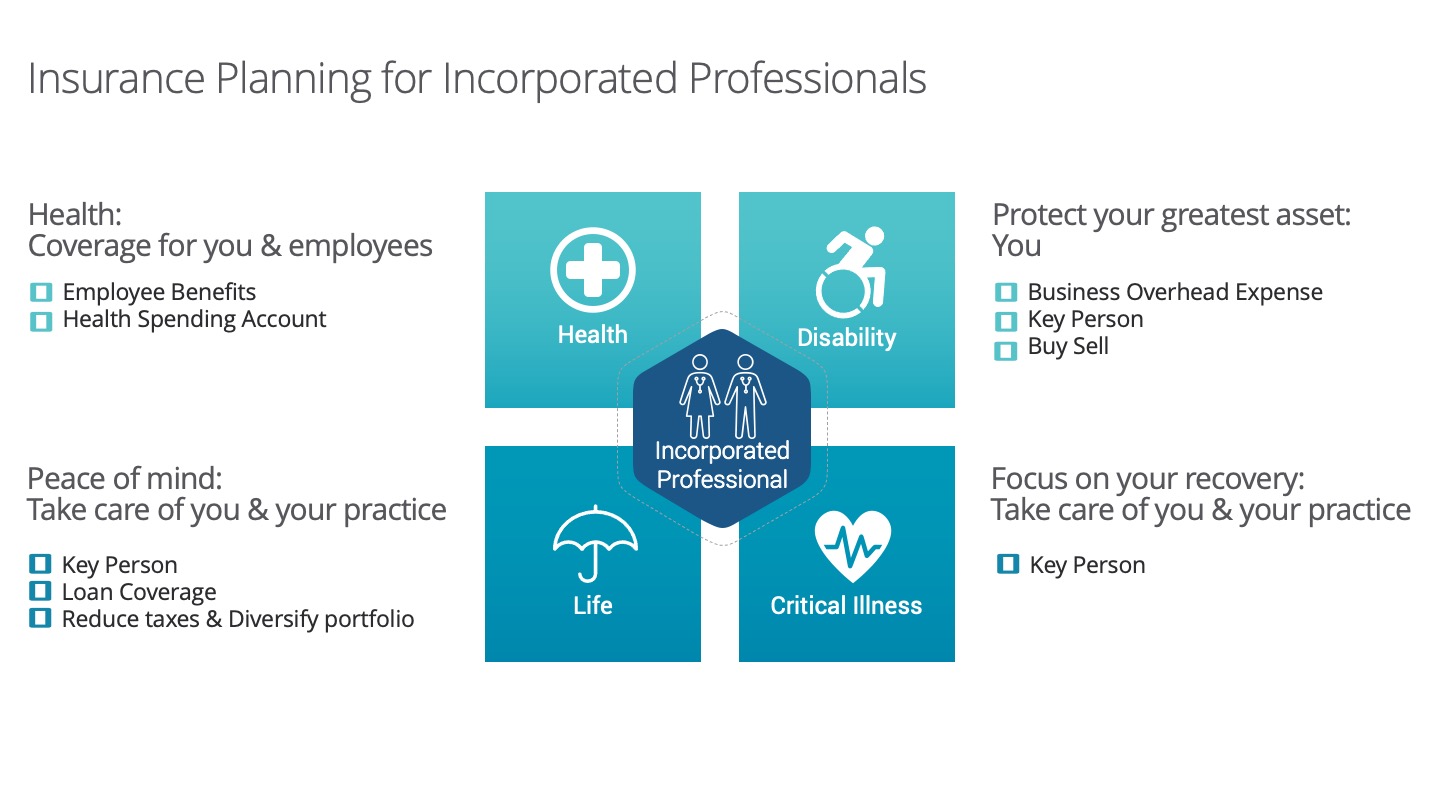
For incorporated professionals, making sure your practice is financially protected can be overwhelming. Incorporated professionals face a unique set of challenges when it comes to managing risk. Insurance can play an important role when it comes to reducing the financial impact on your practice in the case of uncontrollable events such as disability, or critical illness. This infographic and article address the importance of corporate insurance.

The 4 areas of insurance a incorporated professional should take care of are: 

  • Health 

  • Disability 

  • Critical Illness 

  • Life

Health: We are fortunate in Canada, where the healthcare system pays for basic healthcare services for Canadian citizens and permanent residents. However, not everything healthcare related is covered, in reality, 30% of our health costs* are paid for out of pocket or through private insurance such as prescription medication, dental, prescription glasses, physiotherapy, etc.

For incorporated professionals, offering employee health benefits make smart business sense because health benefits can form part of a compensation package and can help retain key employees and attract new talent.

For incorporated professionals that are looking to provide alternative health plans in a cost effective manner, you may want to consider a health spending account.

Disability: Most people spend money on protecting their home and car, but many overlook protecting their greatest asset: their ability to earn income. Unfortunately one in three people on average will be disabled for 90 days or more at least once before the age of 65.

Consider the financial impact this would have on your practice if you or a key employee were to suffer from an injury or illness. Disability insurance can provide a monthly income to help keep your practice running.

Business overhead expense insurance can provide monthly reimbursement of expenses during total disability such as rent for commercial space, utilities, employee salaries and benefits, equipment leasing costs, accounting fees, insurance premiums for property and liability, etc.

Key person disability insurance can be used to provide monthly funds for you or key employee while they’re disabled and protect the business from lost revenue while your business finds and trains an appropriate replacement.

Critical Illness: For a lot of us, the idea of experiencing a critical illness such as a heart attack, stroke or cancer can seem unlikely, but almost 3 in 4 (73%) working Canadians know someone who experience a serious illness. Sadly, this can have serious consequences on you, your family and business, with Critical Illness insurance, it provides a lump sum payment so you can focus on your recovery.

Key person critical illness insurance can be used to provide funds to the practice so it can supplement income during time away, cover debt repayment, salary for key employees or fixed overhead expenses.

Buy sell critical illness insurance can provide you with a lump sum payment if your business partner or shareholder were to suffer from a critical illness. These funds can be used to purchase the shares of the partner, fund a buy sell agreement and reassure creditors and suppliers.

Life: For an incorporated professional, not only do your employees depend on you for financial support but your loved ones do too. Life insurance is important because it can protect your practice and also be another form of investment for excess funds.

Key person life insurance can be used to provide a lump sum payment to the practice on death of the insured so it can keep the business going until you an appropriate replacement is found. It can also be used to retain loyal employees by supplying a retirement fund inside the insurance policy.

Loan coverage life insurance can help cover off any outstanding business loans and debts.

Reduce taxes & diversify your portfolio, often life insurance is viewed only as protection, however with permanent life insurance, there is an option to deposit excess funds not needed for operations to provide for tax-free growth (within government limits) to diversify your portfolio and reduce taxes on passive investments.  

Talk to us to make sure you and your practice are protected.

Life Insurance after 60- is it necessary?

You may have had life insurance for as long as you can remember. You wanted to make sure that your family would be taken care of and be able to pay their bills if anything happened to you.

But now that you’re older and your children are grown – and hopefully your mortgage is paid off – you may not feel you still need life insurance. This could be a valid assumption; however, there are some circumstances under which it may still make sense for you to have life insurance. They are:

  • You still have substantial debt.

  • You have dependent children or grandchildren.

  • You want to leave a financial legacy.

You still have substantial debt

No one likes the thought of leaving their loved ones to pay their debts if they die. If, however, someone has co-signed a loan with you – for example, for a mortgage or a car – and you die, then they will be on the hook for the entire amount.

If you have life insurance and name your co-signer as the beneficiary, this will help relieve any financial burden your death could cause them.

You have dependent children or grandchildren

If you have children who are still dependent on you because they have a mental or physical disability, life insurance can be an excellent way to ensure they will still have access to funds after you die.  Lifelong care can be expensive, and a life insurance benefit will go a long way to helping fund it.

You may have grandchildren you are caring for or that you are not responsible for but want to leave money they can use towards higher
education.  A life insurance payout can be a great way to help a grandchild get a good start in life without having to go into debt.

You want to leave a financial legacy

You may not have dependent children or grandchildren but still want to leave them something when you die. Life insurance can be a great way to do this without cutting back on your spending during your lifetime.

Life insurance can also help make sure that you have something to leave everyone in your will. If you have a family cottage, it can
be complicated to leave it to more than one person or family. Life insurance gives you the option to leave one person or family the cottage and another person or family the cash equivalent.

We can help you!

If you’re unsure whether or not it still makes sense to have life insurance after the age of 60, we’d be happy to sit down with you and talk through your options. Give us a call or email us today!

Insurance Planning for Business Owners

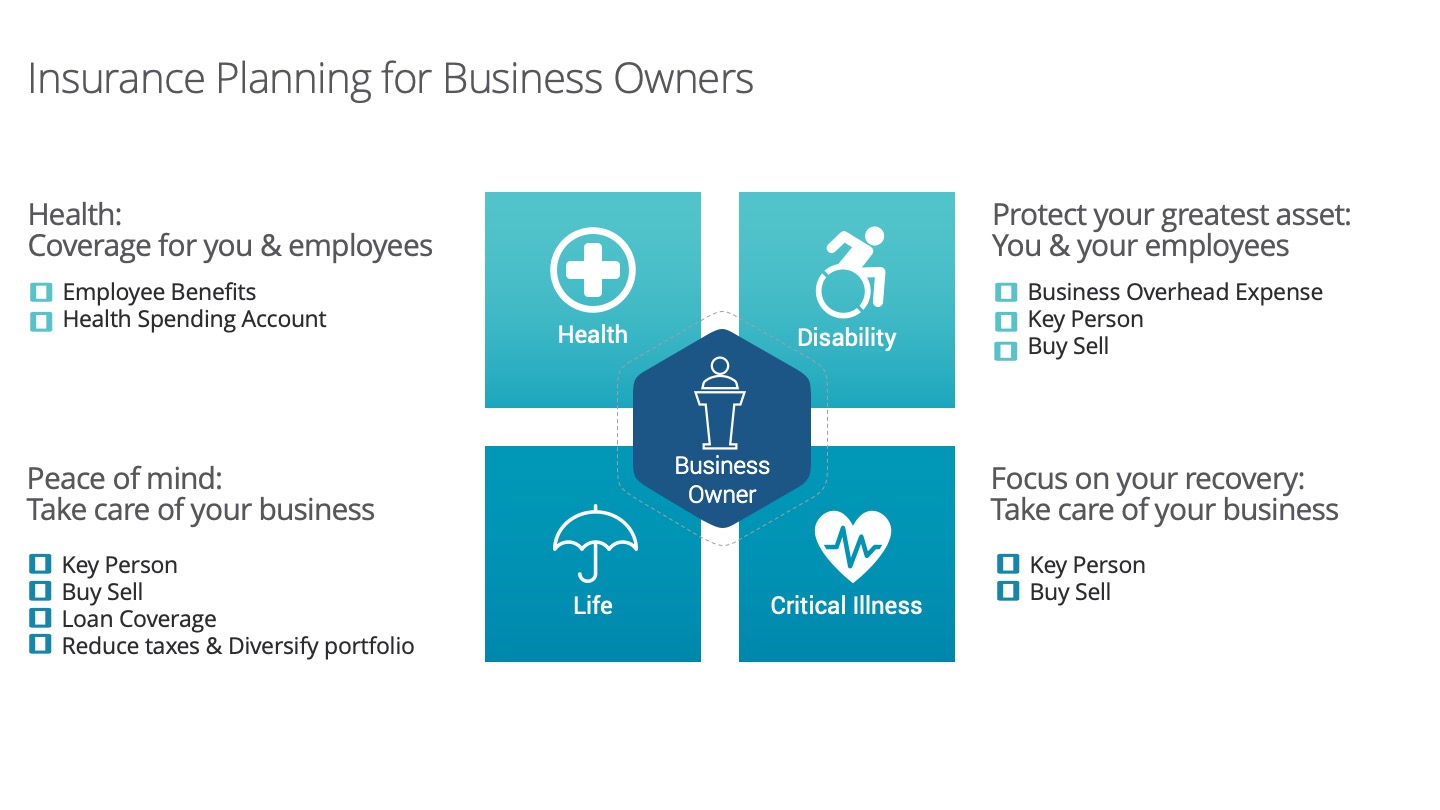
For business owners, making sure your business is financially protected can be overwhelming. Business owners face a unique set of challenges when it comes to managing risk. Insurance can play an important role when it comes to reducing the financial impact on your business in the case of uncontrollable events such as disability, critical illness or loss of a key shareholder or employee.

This infographic addresses the importance of corporate insurance.

The 4 areas of  insurance a business owner should take care of are:

  • Health

  • Disability

  • Critical Illness

  • Life

Health: We are fortunate in Canada, where the healthcare system pays for basic healthcare services for Canadian citizens and permanent residents. However, not everything healthcare related is covered, in reality, 30% of our health costs* are paid for out of pocket or through private insurance such as prescription medication, dental, prescription glasses, physiotherapy, etc.

For business owners, offering employee health benefits make smart business sense because health benefits can form part of a compensation package and can help retain key employees and attract new talent.

For business owners that are looking to provide alternative health plans in a cost effective manner, you may want to consider a health spending account.

Disability: Most people spend money on protecting their home and car, but many overlook protecting their greatest asset: their ability to earn income. Unfortunately one in three people on average will be disabled for 90 days or more at least once before the age of 65.

Consider the financial impact this would have on your business if you, a key employee or shareholder were to suffer from an injury or illness. Disability insurance can provide a monthly income to help keep your business running.

Business overhead expense insurance can provide monthly reimbursement of expenses during total disability such as rent for commercial space, utilities, employee salaries and benefits, equipment leasing costs, accounting fees, insurance premiums for property and liability, etc.

Key person disability insurance can be used to provide monthly funds for the key employee while they’re disabled and protect the business from lost revenue while your business finds and trains an appropriate replacement.

Buy sell disability insurance can provide you with a lump sum payment if your business partner were to become totally disabled. These funds can be used to purchase the shares of the disabled partner, fund a buy sell agreement and reassure creditors and suppliers.

Critical Illness: For a lot of us, the idea of experiencing a critical illness such as a heart attack, stroke or cancer can seem unlikely, but almost 3 in 4 (73%) working Canadians know someone who experience a serious illness. Sadly, this can have serious consequences on you, your family and business, with Critical Illness insurance, it provides a lump sum payment so you can focus on your recovery.

Key person critical illness insurance can be used to provide funds to the company so it can supplement income during time away, cover debt repayment, salary for key employees or fixed overhead expenses.

Buy sell critical illness insurance can provide you with a lump sum payment if your business partner or shareholder were to suffer from a critical illness. These funds can be used to purchase the shares of the partner, fund a buy sell agreement and reassure creditors and suppliers.

Life: For a business owner, not only do your employees depend on you for financial support but your loved ones do too. Life insurance is important because it can protect your business and also be another form of investment for excess company funds.

Key person life insurance can be used to provide a lump sum payment to the company on death of the insured so it can keep the business going until you an appropriate replacement is found. It can also be used to retain loyal employees by supplying a retirement fund inside the insurance policy.

Buy sell life insurance can provide you with a lump sum payment if your business partner or shareholder were to pass away. These funds can be used to purchase the shares of the deceased partner, fund a buy sell agreement and reassure creditors and suppliers.

Loan coverage life insurance can help cover off any outstanding business loans and debts.

Reduce taxes & diversify your portfolio, often life insurance is viewed only as protection, however with permanent life insurance, there is an option to deposit excess company funds not needed for operations to provide for tax-free growth (within government limits)  to diversify your portfolio and reduce taxes on passive investments.

Talk to us about helping making sure you and your business are protected.

10 Essential Decisions for Business Owners

10 Essential Decisions for Business Owners

Business owners are busy… they are busy running a successful business, wearing lots of hats and making a ton of decisions. We’ve put together a list of 10 essential decisions for every business owner to consider; from corporate structure to retirement and succession planning:

  • Best structure for your business (ex. Sole Proprietor, Corporation, Partnership)

  • Reduce taxes

  • What to do with surplus cash

  • Build employee loyalty

  • Reduce risk

  • Deal with the unexpected

  • Retire from your business

  • Sell your business

  • Keep your business in the family

  • What to do when you’re retired

As a financial advisor, we are uniquely positioned to help business owners, talk to us about your situation and we can provide the guidance you need.